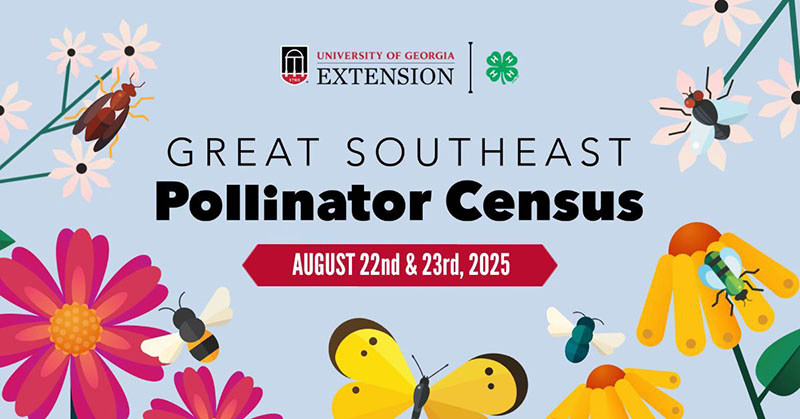
Citizen Scientists Wanted to Count Pollinators
The Great Southeast Pollinator Census is a citizen science project created by the University of Georgia. It is open to residents of Georgia, Florida, Alabama, North Carolina and South Carolina. It is designed for everyone to participate and make a difference for pollinator conservation!
The City of Clearwater and the Pinellas Chapter of the Florida Native Plant Society are hosting a two-day counting event at Moccasin Lake Nature Park from 8 a.m. to 11 a.m. on Friday, August 22nd and Saturday, August 23rd.
Participants will be assigned a small area of the butterfly garden in the park and for 15 minutes, will be asked to record their observations on a count sheet. Identification will be by category, of the following kinds of pollinators:
- bumblebees
- honeybees
- carpenter bees
- small bees (smaller than honeybee)
- wasps
- butterflies
- other pollinators
The organizers will collect the count sheets from participants, summarize them, and submit the data to the University of Georgia. Count sheets and other information will be provided to participants.
If you’d like to take part, please RSVP by completing the appropriate form below, either for Friday, August 22nd or Saturday August 23rd.
Learn more about our native bees by downloading the "Bee Basics" and "Bumblebees of the Eastern United States" books from the Pollinator Partnership's website (free!): www.pollinator.org/shop/books
Questions? Please email Jan Allyn: jallyn727@gmail.com.

Frequently Asked Questions:
-
Q: What is the difference between bees and wasps?
A: They are related. Bees evolved from wasps, but are largely vegetarian whereas most wasps are predators. - Q: How many bee species are there?
A: According to the Florida Museum of Natural History, there are over 4,000 bee species in the United States. Over 300 of those are found in Florida, with 29 species being endemic here. -
Q: Are honeybees native?
A: No. Honeybees were imported from Europe, in the same way cattle, horses, and other species were brought to the United States for agricultural use. - Q: Do native bees make hives?
A: While some Florida bee species are social and live in colonies with a queen, and others live in communities that share a space but with separate nesting chambers, most Florida species are not communal. Individual bees make their nests away from other bees, tunneling in the ground or nesting in hollow stems, rotting wood, or in holes dug by other animals. -
Q: What Florida crops are pollinated by bees?
A: Major Florida crops that benefit from bee pollination include cucumber, watermelon, specialty citrus, squash, strawberries, avocados, blueberries and eggplant. - Q: Besides bees, what other pollinators are in Florida?
A: Other Florida pollinators include butterflies, wasps, flies, beetles, ants, bats, and hummingbirds.


